
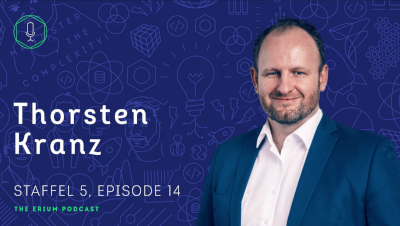
In this episode of The Erium Podcast, I had the pleasure to be hosted by Timo Steininger. Our conversation explores the intersection of logistics and data science, highlighting how one of the world's largest logistics companies leverages AI to optimize its core operations. We discuss the strategic integration of data science at Deutsche Post DHL, specifically focusing on our organizational model, the use of machine learning to optimize last-mile delivery through driver intuition, and the importance of fostering a company-wide data culture.
Key Highlights and Insights
-
Role and Background: Talking about my role then at DHL, my background in physics and cognitive neuroscience, and how I transitioned from consulting to my role in DHL, balancing technical leadership with strategic management [02:42].
-
The "Homebase" Model: The department is organized into "Homebases"—small communities of experts that provide a sense of belonging and specialized support (e.g., in forecasting or operations research) while staffing projects cross-functionally [05:31].
-
Logistics Use Case: Delivery Optimization:
-
Route Planning: The team uses machine learning to learn "ideal tours" from the behavior of experienced delivery drivers [23:31]. Instead of strictly imposing mathematical paths, the system incorporates driver feedback and local knowledge (e.g., knowing a shop is closed for lunch) [28:14].
-
Delivery Windows: They developed regression models to predict 90-minute delivery windows for customers [24:40]. Thorsten notes that they prioritize accuracy; if the model is too uncertain, they won't send an announcement rather than risk providing false information [38:29].
-
-
Data Culture and Strategy:
-
Scale: The company manages millions of tours and over a billion parcels annually, providing a massive dataset for training models [24:22].
-
Impact: Digitalization and analytics are part of the "Strategy 2025," with a goal of contributing €1.5 billion in annual benefit by 2025 [53:11].
-
Training: To foster a data-driven culture, they have trained over 10,000 employees through e-learning and 1,000 managers in intensive workshops [14:31].
-
Technical Deep Dive
-
Algorithm Preferences: I emphasized that data quality often matters more than the specific algorithm [44:14]. I express a preference for tree-based models for tabular data due to their interpretability [44:55].
-
Historical Context: I reflect on the "pioneer days" of 2007, when tools like Scikit-learn or TensorFlow didn't exist, and researchers had to code many functions from scratch [17:51].
-
Open Source Inspiration: I shared his admiration for John Hunter, the creator of Matplotlib, noting the library's roots in neuroscience data visualization [47:58].
Advice for Professionals
I encourage young professionals to find their "sweet spot" within the broad field of data science [01:00:42]. I argue that whether one prefers "hardcore" coding, business integration, or statistics, long-term excellence comes from following one's genuine passion [01:00:54].
Video URL: https://www.youtube.com/watch?v=yeKJEQdEGtQ