For decades, software teams were built around one scarce resource: the time of developers.
Think of a typical project setup. A product owner talks to customers. Business analysts collect requirements. A scrum master runs the process. Then there are technical roles - architects, maybe a tech lead - and finally the developers themselves, often split into front end and back end. Requirements get structured into epics and user stories, refined in grooming sessions and planned in sprint plannings.
All of this has a purpose: to protect the precious time of the people who write the code. Writing software was expensive and slow, so everything upstream was organized to make sure developers only worked on well-prepared, well-understood tasks.
With AI coding agents, that assumption no longer holds.
Writing code is no longer the bottleneck
Writing code was never the only thing developers did. A new Harvard study of 720,000 engineers at 655 companies finds that engineers spend only 30-40% of their time writing code; the rest goes to planning, review and other work (Chen & Stratton, 2026). And that part is now accelerating fast. Twelve months after companies adopted AI coding agents, pull requests went up 36% and lines of code 44%.
But resolved tickets rose only 14%. The extra code did not turn into the same amount of extra delivered work.
Last week, I wrote about one reason: review. In the same study, the time from submitting code to its approval grew by 56%. My argument then was that we have to automate much more of the review, rather than hire more senior reviewers. Review may still be a bottleneck for now. Writing code definitely isn’t.
So where does the time go? In many cases, the slow part sits before the first line of code: collecting the requirements properly, structuring them, and getting them to the people - and now the agents - who implement them.
The bottleneck moves to intent
Practitioners who push AI coding hardest describe the same shift. Lauren Tan, who ships thousands of pull requests a month with coding agents, puts it this way: the bottleneck “these days is the transfer of your intent, right, and your vision to the agent” (Pocock & Tan, 2026, 07:27). In her view, this is why domain expertise matters more than ever: a person with a clear picture of what to build, and enough technical curiosity to work with agents, has a big advantage.
Anthropic’s new study of 58 companies adopting AI comes to a similar conclusion at the level of the organization. As production speeds up, “agreeing on what to build across the organization can become slow and costly” (Anthropic, 2026).
When building becomes cheap, deciding what to build becomes the expensive part.
Every hand-off loses information
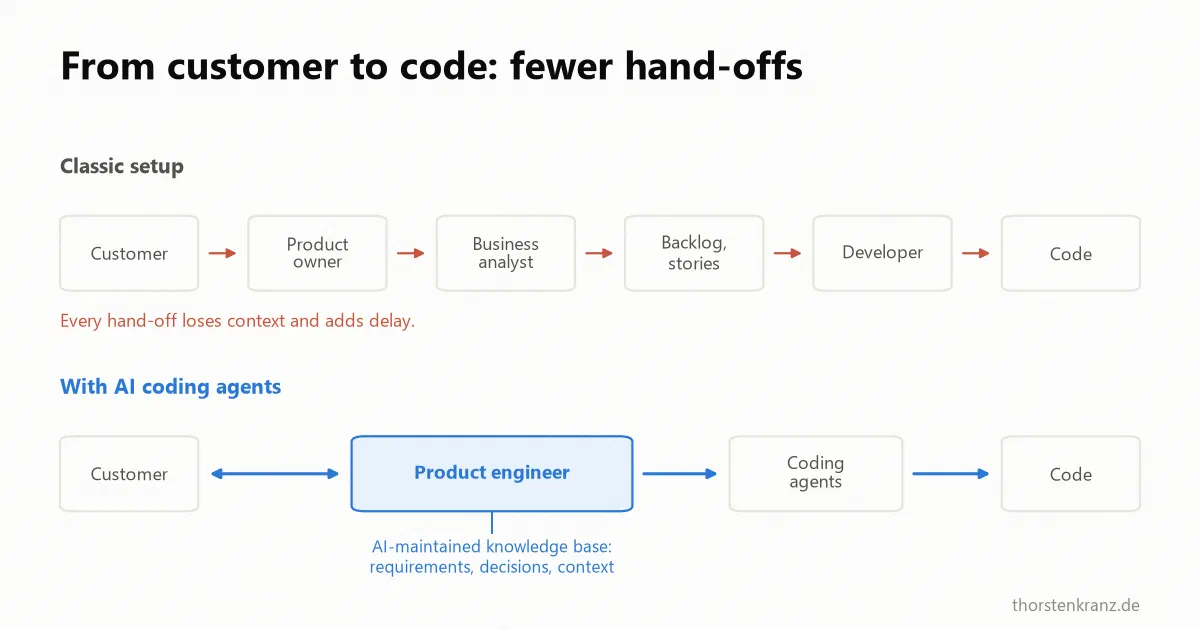
Now look at the classic setup again, with this in mind. A customer explains a problem to a product owner. The product owner discusses it with a business analyst. The analyst writes user stories. The stories are refined in a grooming session, estimated and planned. A developer picks one up, interprets it, and - today - turns it into instructions for a coding agent.
Each step is a hand-off between people. Each hand-off implies communication and knowledge transfer, and each one loses something: context that seemed obvious, a nuance the customer mentioned in passing, the reason behind a requirement. Each hand-off also adds delay, because the next person in the chain has their own queue.
As long as writing code took weeks, these costs were acceptable. They were small compared to the implementation itself, and the structured process protected the expensive part. When the implementation takes hours, the balance flips. The hand-offs are now a large share of the total lead time, and the information lost along the way shows up as rework.
The Anthropic study reports exactly this effect. One executive described merging lead sourcing, account executive and customer success into a single role, because AI tools made it easier to keep up with the details of each step, and made the “context loss” of handing a task off to a colleague more costly (Anthropic, 2026).
Research on how firms organize points in the same direction. A recent Google DeepMind paper models firm output as limited by coordination - communication costs, tacit knowledge, misaligned incentives - more than by the competence of individual workers (Imas, Koh & Legg, Google DeepMind, 2026). It is a theoretical model with illustrative numbers, not a measurement. But its core idea fits what we see: more competent tools do not help much if the coordination around them stays the same.
What we observed in our projects
In our own projects, we saw a pattern that matches this. Where individuals or very small groups were able to bridge the gap end to end, the results were clearly better.
What does bridging the gap mean in practice?
- Talk to the customer directly. No chain of intermediaries between the person with the problem and the person who builds the solution.
- Translate the conversations into business requirements, with the support of AI. Interview notes, documents and decisions go into a structured, AI-maintained knowledge base. The AI helps to summarize, structure and cross-check; the human decides what matters.
- Use these requirements to instruct AI coding agents. The same knowledge base that captures what the customer needs becomes the context for the agents that build it.
Done this way, we saw more complete solutions, faster and better results, and much less friction along the full life cycle of a project - from the first conversation to operations.
The knowledge base matters more than it seems
One pattern that works well for this is the “LLM Wiki” proposed by Andrej Karpathy. Instead of searching a pile of documents from scratch for every question, an LLM builds and maintains a set of linked pages - one per topic - from the raw sources, and keeps them consistent as new material arrives. The original documents stay untouched; the wiki is a curated layer on top.
Adapted to business analysis and software specification, the pages become the project’s core artifacts: business requirements, stakeholder positions, decisions and the reasons behind them, the solution design, interfaces and open questions. Interview notes, workshop transcripts and existing documents go in as sources. The LLM structures them, links them and flags contradictions; the human decides what is right. Local search over the original files completes the picture, so both people and coding agents can always get from a summary page to the details behind it.
There is early evidence that this combination helps. In Anthropic’s tests on a corpus of about 350,000 files, Claude answered 61% of the questions correctly with search plus an LLM-maintained wiki, against 53% with search alone (Anthropic, 2026). These are the vendor’s own tests, but the direction matches what we see.
For a project, this means requirements are no longer scattered across meeting notes, tickets and people’s heads. They live in one place, in a form both humans and agents can read.
It has a welcome side effect: if the knowledge foundation is consistent, many documents no longer need to be built by hand. Status updates, stakeholder presentations, even PowerPoint decks can be generated from the same pages, in an automated way and always up to date. The hours that used to go into assembling slides can go into talking to customers and building.
Others are seeing the same
We are not the only ones. The companies in the Anthropic study describe several variants of the same move (Anthropic, 2026):
- One manager explained that “we essentially collapse designer, product manager, engineer, and QA, and even infrastructure, into a singular role.”
- A healthcare startup asked all of its engineers - not just its business people - to speak regularly with the medical professionals who use its product.
- A startup founder employs only individual contributors, each owning a distinct part of the product and the business.
- An engineering leader summarized: “Two people plus Claude is the most amazing thing… if two people agree on something, just ship it.”
The authors’ explanation is the same as above: the more a single person or a small team controls an entire workflow, the less the coordination costs appear.
There is also a warning from the other direction. Steve Yegge described at the AI Engineer Code Summit how his game shipped new features so fast with agents that players came to him asking for a road map, because the pace was too much (AI Engineer, 2026). Output without product direction does not create value. Someone has to decide what is worth building, and in what order.
A new role: product owner and engineer in one person
This approach needs a new kind of role. I call it the product engineer. Some startups already use the term for engineers with product sense; I mean it in a broader sense: a person who combines the product owner and the engineer, two profiles that used to sit at opposite ends of the chain.
On the technical side, this person:
- makes technical decisions, including high-level decisions on software architecture,
- knows how to instruct AI coding agents and how to check what they produce,
- sets up the guardrails - tests, checks, review - that keep quality up when code is produced fast.
On the business side, the same person:
- talks to customers, business owners and other stakeholders,
- turns those conversations into a clear statement of what is needed,
- defines the business value and what the project should achieve - and decides what not to build.
Neither half is new. Good product owners have always needed some technical understanding, and good senior engineers have always talked to their users. What is new is that one person can now do both at the pace a project needs, because AI takes over much of the work in between: structuring notes, drafting specifications, writing and testing code.
Interestingly, the documents this role produces look familiar. Ethan Mollick observed that classic delegation documents - product requirement documents, design intent documents, detailed deliverable specs - “work remarkably well as AI prompts” (Mollick, 2026). The craft of writing a good requirement does not go away. It becomes the most direct way to steer the implementation.
Limits and open questions
This is not a model for every project, and it raises questions I don’t have full answers to.
Not every system fits into one head. Large platforms, safety-critical systems and heavily regulated domains still need specialists - for security, for compliance, for operations at scale. The DeepMind paper makes the point that complementary specialists can outperform a single generalist when the weakest domain limits the result (Imas, Koh & Legg, 2026). The product engineer works best where a small team can own a product end to end.
Review does not disappear. Code written fast still needs to be checked, and the Harvard study shows how much review effort has already grown (Chen & Stratton, 2026). A product engineer who ships without verification is just a faster way to produce bugs.
Where do these people come from? The profile needs experience on both sides. At the same time, entry-level hiring in the most AI-exposed occupations has slowed: the Cleveland Fed finds that job-finding rates there dropped about six points more than in less exposed occupations (Cleveland Fed, 2026). If juniors don’t get the chance to learn both sides, there won’t be many seniors who can do this job in ten years.
Concentration risk. When one person holds the customer relationship, the requirements and the technical decisions, that person becomes a single point of failure. The structured knowledge base helps here: if the requirements and decisions live in a shared, readable place instead of in one person’s head, someone else can take over.
What this means for leaders
If I were setting up a software team today, I would start from the product, not from the roles:
- Give small teams end-to-end ownership - from the customer conversation to production - and cut the hand-offs in between wherever possible.
- Develop the product engineer profile deliberately. Pair technical people with customer contact, and give product people the technical training and tools to instruct agents. Both directions work; neither happens by itself.
- Invest in the knowledge layer. Requirements, decisions and context should live in a structured place that humans and agents can both read. This is what makes small teams fast and keeps them from depending on a single person.
- Measure lead time from the first customer conversation to production, not lines of code or pull requests. That is where the hand-off costs show up.
Product owners, business analysts and scrum masters don’t disappear overnight. But the classic setup was designed for a world where writing code was the scarce resource. That world is changing fast, and team structures should follow.
I’m curious how you see this. Are you already seeing this kind of role emerge in your teams - and where does it work, and where not?