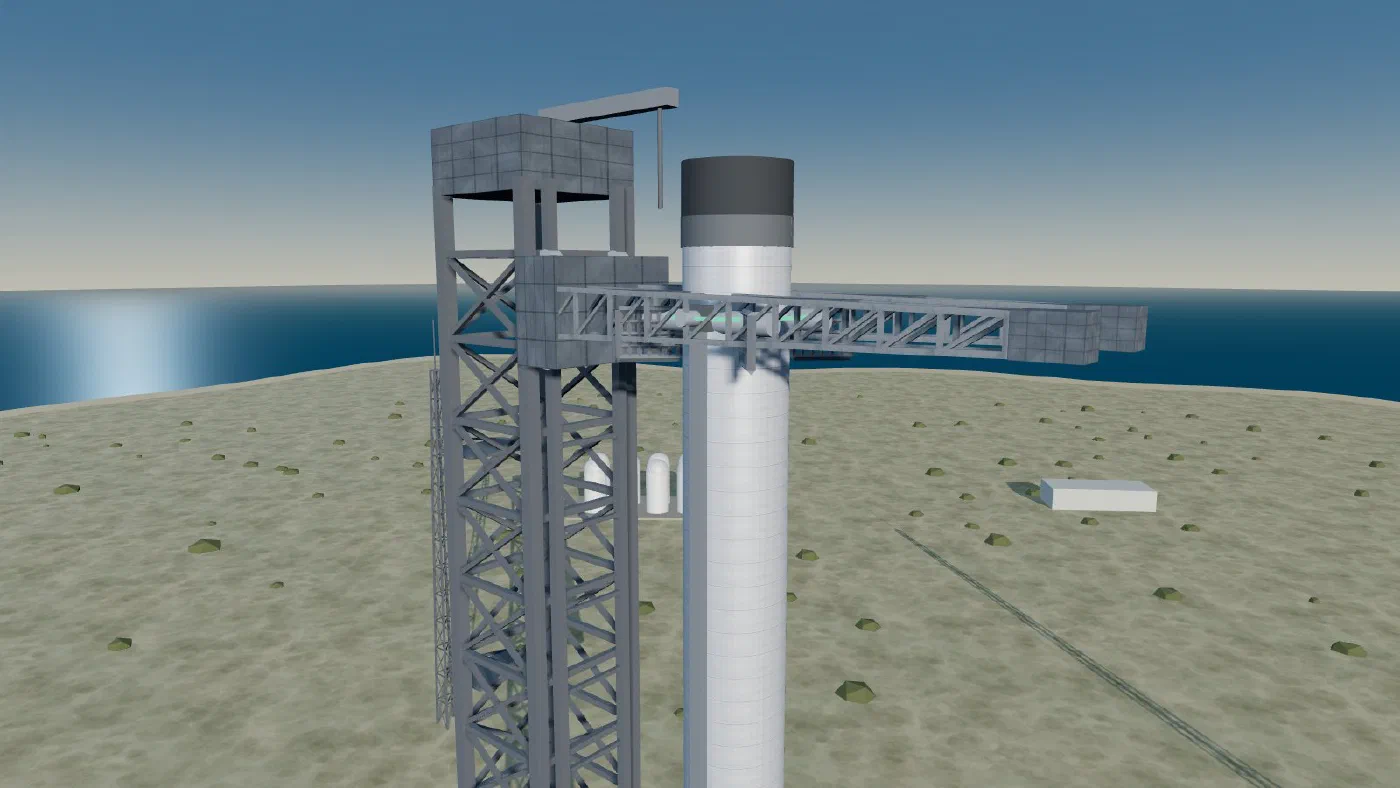
My latest side project is Rocket Catch, a browser flight simulator of the Starship chopstick catch: seventy metres of empty steel falls out of the sky at 85 m/s, and you have one landing burn to thread it between two arms of the launch tower. It runs in the browser, on desktop and on phones, with no installation.
Try it: https://rocketcatch.thorstenkranz.de/
Why I built it
Flight 15 was meant to be the first time both stages came back to the tower. The ship made it, caught out of the sky. The booster never got its attempt: with not every parameter nominal, the call was made to put it in the water instead.
On video, the catch looks almost unhurried. Nothing in the footage tells you what it cost to make it look that easy. So the idea is simple: fly it yourself. You will put a lot of steel into the ground, and that is not the game being unfair; it is the manoeuvre being hard. After twenty wrecks, the real footage looks different. That is the whole point: not to simulate a rocket, but to earn the right to be impressed by one.
The game lets you take either seat on Flight 15, including the booster attempt nobody actually made.
Four gates, all at once
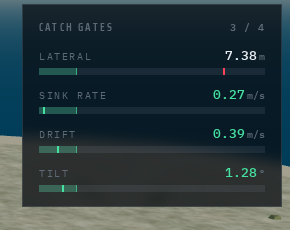
The tower does not slow the vehicle down; it only holds what arrives correctly. At the moment the catch pins cross the arms, four limits must be met at the same time:
| Gate | Limit |
|---|---|
| Lateral offset | 1.50 m |
| Sink rate | 2.00 m/s |
| Drift | 0.80 m/s |
| Tilt | 2.00° |
Two vehicles, two problems
- Super Heavy comes down cold and accelerating. The engines only steer while they are lit, so without them you have little more than five seconds of cold gas. Light the burn too late and you arrive as a crater; too early and you climb away from the tower with empty tanks.
- Ship comes home belly-first at about 87 m/s, steering on four flaps. Around 700 metres you commit to the flip, and a single sea-level Raptor leaves you less than 1 g of margin.
Under the hood
The simulation uses real masses and thrust and a deterministic flight model with a fixed physics step, rendered in 3D with three.js. A built-in autopilot drives the same controls you do and shows what it is pressing and why. It exists to prove the thing is landable, and even with perfect knowledge of the vehicle’s state, it misses roughly one in three booster landings.